
Fighting 4 Salvation:
A Pragmatic Path Toward Restoring Christendom through Catholic Shires
J. Scott Moody, M.A.
V 1.0
This book is dedicated to all the souls that were lost due to lukewarm Catholicism . . .
Chapters
I. Preface
II. Introduction
III. A Note About the Catholic Church
IV. A Note on the “Benedict Option”
V. The Pyramid of Civilization
VI. Worship: “I Am the Truth and the Light”
VII. Kingship: Power is King
VIII. Kinship: The Heart of the Family
IX. Entrepreneurship: The Business of Exchange
X. The Pyramidal Balance Today
XI. Restoring Christendom—The Catholic Shire
XII. Shire Example: Berlin-Gorham, New HampShire
XIII. Conclusion
Please note the version number you are reading. I expect to make frequent updates and changes to this ebook as I gather more feedback and experience. The most up-to-date version will be available on my substack: www.fighting4salvation.substack.com
For a printable pdf of this ebook, click download below:

I. Preface
Imagine a place—a village, a town, or a city—whose people are majority devout Catholics. And not just Catholic, but a place where everyone is striving towards the ultimate goal—salvation!
Imagine a place where artisans celebrate Catholicism through their working of soil, wood, clay, or stone. Some will be tasked to the most important project of all—the building of new majestic, gothic cathedrals!
Imagine a place where multi-generational families are the norm. Where children can grow-up secure in their faith, find their spouses, and begin their own families—the growing domestic church!
Imagine a place where there is active protection of Catholic life and property. To that end there needs to be a bridge over the gap between civic and religious governance—enter the Eques Protectors “Knight Protectors!”
We shall call this place—the Catholic Shire!
II. Introduction
“Woe to those who call evil good, and good evil; who substitute darkness for light, and light for darkness; who substitute bitter for sweet, and sweet for bitter!” Isiah 5:20
Make no mistake about it, evil is ascendant. Our homes are permeated by evil as it invisibly wafts through the very air that we breathe via TV, wifi, or cellular. The barrage is ceaseless, and it is overwhelming. How do we even begin to fight for our salvation—for yourself, your family, and your friends?
We have to be the light amidst this darkness. While still numerous in America, devout Catholics are too scattered and too busy to mount an effective assault on this growing evil. I personally struggle with this every single day and the ideas put forth here have become front-and-center for me.
It is not an exaggeration to say that this ebook has spent 30 years in the making. For much of that time I imagined that this would one day be a multi-volume tome akin to the “Rise and Fall of Rome.” I have dramatically shifted course and now purposively remind myself that this ebook is fundamentally a call-to-action.
As such, do not expect to find detailed footnotes or much of a literary biography. I hope that in the course of this introduction, in other chapters, and on my substack, that the people and their ideas that have been weaved together will become evident—just not in a formal way.
Besides, the older I get the more I realize that there really is nothing new under the sun. At best, I’ve just assembled and packaged this information in a different manner.
To put it simply, you and I just don’t have the time for yet another academic exercise but rather a call to action. A call that must result in the change of course for millions of Catholics if we are to save our very own souls and, ultimately, all of Christendom.
I’m also not writing this ebook for financial gain. You will find this ebook freely available on my substack--Fighting4Salvation.substack.com--as this fundamental message must be shared far and wide and as quickly as possible.
That said, my time dedicated to this endeavor means, by definition, less time for other activities, especially paying the bills. As such, while paid subscriptions will not be required to read the substack content, I would ask that you consider a paid subscription to support this urgent work.
So, let’s start at the beginning to shed some light on how I ended up on this most unlikely of paths . . . to say that this ebook has been 30+ years in the making is no exaggeration. The “Pyramid of Civilization” was conceptualized during the years of my graduate studies at George Mason University (GMU).
I was drawn to GMU for its program in Austrian Economics. In particular, I found myself drawn to Friedric Hayek and his intellectual followers. Of course, anyone familiar with this intellectual discourse will know that that it extends well beyond mere “economics.”
Another important lesson I learned in graduate school is the extreme balkanization of scholarly thought. Put simply, it is the old cliché of 3 blindfolded people touching an elephant but only being able to describe the elephant in pieces and never as a whole. I became disenchanted with this reality.
So, after consuming an untold number of books, and for my own need to explain how the world works, I began to put down various ideas in a leather-bound notebook I carried around for many years (now, much to my dismay, lost to eternity). After much whittling, these ideas eventually formed the basis of the pyramid. Some of the books that had the most impact on me were:
· Adam Smith “The Wealth of Nations” and, more importantly, “The Theory of Moral Sentiments.”
· Jane Jacobs, “The Economy of Cities” and all of her other books on urbanization.
· Mark Skousen, “The Structure of Production”
· Thomas Sowell’s culture series: “Race and Culture,” “Migration and Culture,” and “Conquest and Culture.”
· Mark Steyn, “America Alone” and “After America”
· John Horvat, “Return to Order”
And that was the end of that life chapter . . .
For the next life chapter, it too began at GMU. That’s where I met my beautiful and brilliant wife, Wendy (now also the mother of our 5 children). Shortly after we were married, we began searching for a church. We knew we wanted children, although honestly, we weren’t thinking about 5 at the time. And we wanted to raise them around Christianity in a way we were not as children.
While we attended numerous denominations in and around the Imperial City (a.k.a. Washington, D.C.), nothing really stuck. Then one of my friends, Alex, introduced us to a couple—Thomas and Roseanne. While our association was not initially a religious one, we knew that Thomas and Roseanne were, like Alex, devout Catholics.
Ironically, Wendy and I both grew up in Catholic households (Wendy was baptized Catholic, though I was not), but for one reason or another it was never the center of our lives and out of sheer neglect simply fell to the wayside. Little did we know that Thomas was plotting to change that.
Once Thomas became aware of our backgrounds as fallen away Catholics and, of course, our intellectual curiosity he did something that changed my outlook forever. He went after our intellectual curiosity and challenged me to read 4 Papal Encyclicals. Papal what? I had never heard of such a thing . . . so I accepted. They were:
· Rerum Novarum “On the Condition of the Working Class” by Pope Leo XIII
· Popolorum Progressio “On the Development of Peoples” by Pope Paul VI
· Laborem Exercens “On Human Work” by Pope John Paul II
· Sollicitudo Rei Socialis “On Social Concern” by Pope John Paul II
My mind was blown. I had no idea that you could be intellectual and Catholic at the same time. I found myself agreeing with so much that was written down in the pages of these encyclicals. I was hooked. I went through RCIA, was baptized, and we were officially married in the Church.
And then life happened . . . or should I say children happened. While the days flew by, the pyramid was always there “like a splinter in my mind.” Over time that splinter grew into a timber.
Then by sheer happenstance, I ran into the TFP Table (Tradition, Family, and Property) at a major political conference. I learned of their Chivalry camp and, as my boys were getting older, it sounded like a great place to send them during the summer. That’s when they brought back home with them a foreign concept—the Traditional Latin Mass.
Around the same time I became aware of new website called ChurchMilitant.com. For years we consumed everything, most especially Michael Voris’s “The Vortex” which shed light on a problem I witnessed every Sunday—the steady decline in attendance. Why?
Alas, I’m deeply saddened by the role my own diocese (Manchester, NH) played in their demise—though I know it goes much deeper than that, but I digress.
All of this revelation also filtered into my career. Wendy and I developed the “Family Prosperity Index” (also freely available on my substack) to help public policy groups tackle both the economic and social problems plaquing our country.
Some of our findings even startled us—most especially about how the data kept showing time-after-time that religion is the solution to so many of America’s problems. As a result, this ebook is my solution to the problems laid out in the FPI.
Finally, we learned of our own Latin Mass parish in our diocese led by the FSSP (Priestly Fraternity of St. Peter) in Nashua, NH. It was, and still is, a 2-hour drive and we go as much as we can. To go to a Mass where children outnumber adults shows the way our Lord will ultimately fix the problems in the church and the world.
It was during one of these Latin Masses that I felt the first stirring of this entire ebook coming together in my mind at once. And that’s a big step since I have to conceptualize, even write, everything in my mind before I can ever begin writing on paper. Since then, every breakthrough idea I’ve had has come while sitting in the pew at Mass.
In particular, the most glaring problem I see is precisely all the children. As a father of 5 children I constantly worry about what they will do as adults for work, for finding a spouse, and, most importantly, for sustaining their faith.
I’ve witnessed too many large, devout Catholic families struggle keeping their families physically together. There are always siren calls from colleges or jobs pulling away family members.
How can we protect our children from the greater culture just waiting to rip them from their faith and, ultimately, their salvation? And what of our spouses, extended family and friends? And our very own soul?
In the end, we must face the reality that laypeople can’t simply wait for the Church to get its act together. What if the worst happens and the Traditional Latin Mass is banished forever? Do we simply abandon our only path to salvation? Of course not!
We have to do more and this ebook lays out a real-world, institution-building path for laymen to take the lead in their fight for salvation. We are the Church Militant, and it’s about time we started acting like it.
III. A Note about the Catholic Church
This ebook is not a screed against the many controversial topics raging within the Cathlic Church.
As previously noted, my family and I love the Traditional Latin Mass and attend the Diocesan FSSP parish as often as possible—even though it is a 2+ hour drive from Jefferson to Nashua, NH.
Unfortunately, the reality is that we won’t be getting another Latin Mass parish closer to our home anytime soon thanks to Pope Francis’s Traditionis Custodes. And while the verdict is still out on Pope Leo XIV . . . I’m not an optimist.
As laymen, we simply don’t have the authority to challenge the creeping Modernists (Satanists?) Theology that has infected many parts of the Church. That said, there is much we can, and must, do outside of the Church to fight for our own salvation and that will be the topic explored in this ebook.
IV. A Note on the “Benedict Option”
The ideas in this ebook are not about a retreat as often portrayed by proponents of the Benedict Option. Rather we are talking about a consolidation or concentration of the remnants of Catholicism.
The goal is to create as many “shining cities on the hill” as possible that will create new Catholics (via old-fashioned large families) and/or create new converts with the attractive power of a true and faithful Catholic civilization. In the end, we are regrouping the calvary not for retreat, but for the . . . charge!
V. The Pyramid of Civilization
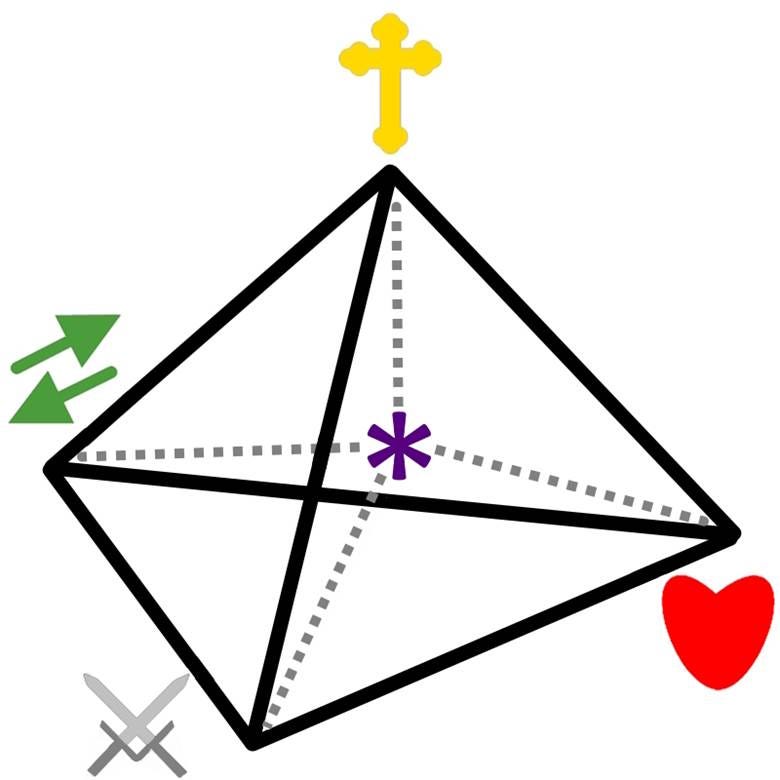
Before we can begin to restore Christendom, we must first understand the necessary ingredients that formed the basis of civilization itself. The way I see it, there are 4 dynamic forces that must be understood in context of itself and, more importantly, their relationship to one another.
The best way to visualize these forces is to envision a four-corner pyramid as shown below. A 4-corner pyramid cannot stand if one corner is missing. The 4-corners must be in balance for the pyramid to stand upright. The same applies to civilization.
The 4 forces are:
1) Worship: “I Am the Way, the Truth and the Life”

2) Kingship: Power is King

3) Kinship: The Heart of the Family

4) Entrepreneurship: The Business of Exchange

The chapters ahead will explore each of these forces and, more importantly, how to keep them in balance in order to keep the pyramid of civilization upright. Keep in mind, however, that the pyramid is never completely skewed toward one corner or another as they are always pulling against one another.
VI. Worship: “I Am the Way, the Truth and the Life”
If history has shown us anything it is that we are built to worship. Humans have literally worshipped just about everything at one point or another—from golden calves of the ancients to the Earth today. Of course, the most prominent being we often come to worship is ourselves.
As humans, we all face one cold stark reality—we will all die. The fear of what comes after death is the only force that can permanently alter a person’s actions. Just witness the countless stories of sinners becoming saints. And only one man (Jesus) has conquered death opening the true path to heaven.
Of course, since there is a heaven there must be a hell. If the beatific vision is not enough to keep one on the straight and narrow, then there is the thought of everlasting torment at the hands of Satan and his demons. In an ironic twist, it was my growing awareness that Satan truly exists that also prompted my return to the Church.
It goes without saying that the only true worship is through Catholicism given to us by our Lord and Savior Jesus Christ. Without Catholicism there is no Christendom which has brought civilizational cohesion to all humans regardless of race or ethnicity.
Also, the belief in an eternal afterlife comes with some practical everyday benefits. In essence it pushes our time-preference into infinity. We are no longer plaqued by what John Horvat calls “frenetic intemperance.”
For example, this extends to the way we view procreation. It is no surprise that in modern America the most religious states also have the most children. Unfortunately, those that reject God are now ascendant which is the primary cause of the oncoming “Demographic Winter”—a situation where deaths outnumber births resulting in absolute population decline (see our Family Prosperity Index for more).
What happens when worship is distorted by . . .
Kingship:
The Catholic Church has long been envied by monarchs for its ability to win the hearts and minds of people. To say nothing of the grand churches and associated wealth that accrued over the centuries.
One of, if not the most, notorious examples was by English King Henry VIII who wanted to break-away from the Vatican so that he could simply divorce his wife. As a consequence, the Church of England was formed and headed, to this day, by the British Monarchy.
Not coincidentally, all Catholic Church property was confiscated as well.
Kinship:
A cult is formed when “bonds of kinship” are used to further the fortunes of a charismatic figure dressed in religious garb. These may not be direct bonds of kinship, but rather the rhetoric of kinship to keep their flock of sheep in line. However, in more extreme cases, polygamy is often involved which does involve direct kinship.
Entrepreneurship:
The church begins to act like a corporatists working to maximize the bottom-line, much like the money-changers in the Temple. This can lead to revenue generating actions, albeit immoral, such as the selling of false relics or taking economic advantage of pilgrims who are far from home.
VII. Kingship: Power is King
What is power? Power derives from the use, or threat of use, of force to rule over a geographic area and its people. Power concentrates quickly through direct conquest or the acquiescence of weaker jurisdictions to stronger ones. Over time, the most effective wielders of power have become kings.
Throughout history man has been ruled by a king—albeit different cultures use different words such as Pharoah, Czar, Emperor, etc. Whatever the name, the law of the land resided in a singular person. This kingship is the natural outcome of the pursuit of power.
What happens when kingship is distorted by . . .
Worship:
A theocracy forms when the priestly caste of a religion are also the political kings—Modern Iran for example. In this case, religious laws become the civil laws. However, this is untenable because religion can only be followed by the will of the heart, not by the brute force of government.
Not surprisingly, theocracies become brutal authoritarian regimes that stamp any dissent, especially other religions.
Kinship:
Kinship, more broadly defined as genetic similarity, has long been a basic form of consolidating power—often referred to as tribalism. It is easier to identify “friend or foe,” but also leads just as easily into violence since there are not many other means of settling disputes between differing tribes.
Entrpreneurship:
During the colonial age, huge trading companies became larger than many governments at the time. They not only commanded great resources, but could even field mercenary armies to either protect or expand their interests.
Even today there are wealthy individuals who wield massive global influence—think George Soros or Bill Gates—who can reshape entire countries. They are, in essence, a borderless king fueled by their lucre.
VIII. Kinship: The Heart of the Family
With kinship it is blood that binds people together. Of course, the most important illustration of that blood relationship is between a parent and child. It is the strongest and truest form of the human bond that is love. The extent of kinship lessens as it radiates away from the core parent-child relationship.
As any parent knows, despite having a deep well of love for their children they can and will quickly test the limits of that love. Yet, that bond is nearly unbreakable for good reason. For children the hardest lesson to learn in life is how to fail gracefully. The family is the safe harbor where failure can occur and important lessons learned without long-term consequences.
For example, every child goes through the rite of passage of learning how to ride a bike for the first time. Failure is the rule the first dozen or so tries. If this occurred in front of their peers the child may never learn to ride a bike after enduring the ridicule. In contrast, a parent encourages a child and failure eventually becomes success. This process will play out hundreds of times before the child becomes an adult.
Kinship, however, weakens as the blood-line relationship thins and/or physical proximity to those relationships. Throughout history and cultures families were multi-generational—a concept foreign to today’s “nuclear” families of the parents and children. This balkanization of the family weakens parental support and robs children of loving adult mentors—grandparents, uncles, aunts, cousins, etc.
What happens when kinship is distorted by . . .
Entrepreneurship:
In the absence of family businesses, a corporate world of faceless businesses owned by the wealthy elite only cares for the person and not the well-being of their kin. Business can view people in one of two ways.
· People provide labor for the production of goods and services.
· From the return on labor (compensation), people in turn consume those goods and services.
Whether or not this production/consumption model provides for basic necessities of their family is not part of the corporate equation. To make matters more relevant, the model destroys the soul.
In JD Vance’s “Hillbilly Elegy” he shares the soul-crushing plight of workers who were cast aside by corporations in search of a “higher return.” While their bottom line may have improved, the shattered lives of those left behind became the kindling for the opioid wild-fire that kills over 100,000 people a year (see the Family Prosperity Index for more information)
Kingship:
When power become the goal of families you end up creating mafia/cartel style organizations (not unlike kings of yesteryear). This does not necessarily involve illegal activities we associate with them today. However, the quest for power corrupts and illegal activities often involve the quickest and largest level of riches—drugs, gambling, etc.
Now today we have drug-fueled cartels, the revolve around family-ties, literally running large amounts of territories in place like Mexico and Afghanistan to name just two. These cartels have revenues rivaling Fortune 500 companies and well-armed militias to protect them.
And why are they so often family-based—trust. To build any kind of organization there has to be large degree of trust amongst its members and the kinship ties provide that. They are, put simply, the cancerous form of the good ol-fashioned small family business.
Worship:
The church can only survive with an influx of men into the priesthood and women into the nunnery. From a family perspective the sacrifice of one man to become a priest or woman to become a sister is actually taking their entire future lineage with them—an eternal sacrifice. Too often we do not fully acknowledge the depth of sacrifice being made on our behalf.
As such, families have to be prepared to absorb this sacrifice for the good of the church. Historically this has been done by having large families. The church encourages growth in the Domestic Church in order to keep growing itself.
However, when Church life becomes more appealing than domestic life we may lose so many of our sons and daughters that it can negatively impact the demographic balance of a particular place.
IX. Entrepreneurship: The Business of Exchange
The basis of Austrian economics is that value is subjective and the only way to gain an understating of valuation is through exchange. What will person A give to person B for item X?
Sifting through these vast number of exchanges, some people begin to see economic opportunities. For instance, taking some characteristics of item A and some characteristics of item B will yield an entirely new item C—an item better suited meet people’s needs based on experience.
Today we call these people entrepreneurs because they not only see economic opportunities, but also take on the risks associated with bringing them to fruition. If they are correct, they can generate massive new wealth not only for themselves, but for countless number of others—such as the people invest with them, work for them, or consume the new improved item.
Over time, entrepreneurs work to not only recombine goods, but also to create entirely new goods. Today, we call that technological progress.
What happens when entrepreneurship is distorted by . . .
Worship:
For a long time the charging of interest (usury) was considered immoral, even in Christendom. In economic terms, interest is simply the price of time and like any price is not a matter for theologians (assuming its voluntary in nature and within reasonable bounds, i.e., not disguised theft.)
Nonetheless, lacking a price on time results in the retardation of economic development which, as we now know, ultimately costs an untold amount of lost life-years. An early death to an ill-prepared soul could mean damnation.
The church must tread carefully when making non-spiritual economic proclamations.
Kingship:
Government often finds reasons to tip the scales of commerce in ways favorable to them. In extreme cases, governments will grant monopolies over the trade of certain items. Softer cases involve the use of taxes or regulations to limit competition for favored industries.
The consequences for this interference is that these industries come to rely on the government help as opposed to becoming more efficient. This parasitic relationship can sap the vitality of the broader economy as government imposes harsher measures to keep them afloat.
Kinship:
Tribalistic autarky can occur when a tribe goes to extreme measures to isolate themselves. The lack of interchange with others leads to a stultifying impact that can extend beyond commerce.
For example, consider the state of tribes that have been found deep within the Amazon forest. While this may have been a geographic isolation, as opposed to one willfully chosen, you can see how they have failed to develop beyond a subsentence level.
X. The Pyramidal Balance Today
As shown in the graphic, the pyramidal balance today has shifted away from worship and kinship and toward kingship and entrepreneurship. The reasons are as follows:

Where does Worship stand today?
Unfortunately, the institutional Catholic Church has been corrupted by the “smoke of Satan.” More specifically, the multi-decade attack against the church by Communism, much of it historically via former Union of Soviet Socialists Republics but no less by the Chinese Communist Party in the present, has greatly weakened the church.
Due, in large part, to changes in the Church post-Vatican II, church attendance has plummeted, especially among the young. Without serious shifts in demographics or mass evangelization, the church will essentially cease to exist at all in the lands formerly known as “Christendom.”
With fewer people in the pews, one would also expect a similar drop in church offerings. However, the church has morphed into a giant non-governmental organization (NGO) that feeds at the government trough. So-called Catholic Charities is just one such front the church uses to access government funding.
Adding insult to injury, the Church has found ways to monetize itself even as it continues to do nothing else besides managing the decline. For instance, there is evidence of Dioceses closing churches not so much because of waning attendance, but because of their large endowments. The same goes for monastic orders and their, often valuable, properties.
As a result, the church now more resembles an inward-focused corporatists structure, especially as it provides more services to its government benefactors than to its parishioners. This has pulled the church away from Worship and more toward Kingship and Entrepreneurship.
We need to find a way to continue our faithful journey without the direct aid of the institutional Church hierarchy.
Where does Kingship stand today?
I use to publish a study called the “Private Sector Share of Personal Income.” It showed that over time that private sector derived income was losing ground to public sector derived income. This simply equation explained a significant part of the income differences between states.
Put simply, states with the highest levels of government income were poorer than those with the lowest levels. The reasons stem from the fact that government competes with the private sector for resources such as capital and labor. Unfortunately, the private sector too often loses that competition.
Over time, as history has shown time and again, that government eventually reaches a tipping point where it captures enough resources to become the decisive force in the economy. Is anyone really surprised that members of Congress who were elected as paupers are suddenly nouveau-riche?
As such, kingship today has morphed into a highly centralized government whose purpose is to enrich the entrenched interests or, more specifically, the bureaucracy (a.k.a. “the Deep State”). Making matters worse is that this bureaucracy has a self-selection bias toward progressive secularists that disdain traditional values such as family and religion.
We need to find a way to protect Catholic life and property without the sole reliance on civil (secular) government.
Where does Kinship stand today?
Today’s modern world has done extensive damage to kinship. There is the obvious destruction wrought by divorce that tears families apart. Now we are also witnessing the less obvious destruction wrought by divorce as new generations forgo marriage altogether and the resulting children. The chaos created by divorce is a significant driver of the Demographic Winter looming over us.
There are also other factors tearing at the fabric of kinship—such as the “Florida effect.” Here I’m referring to the “snow-birds,” usually retirees, that flock to Florida in the winter to return to their northern homes in the winter. Why is this a problem?
The problem was aptly demonstrated to me by a donor to a think-tank I once helmed in Maine. He took me to Bridgton, ME, a classic New England town snuggled on the shore of a lake, that today is a shell of its former self. He drove me around town pointing to one house after another remarking that—this person was once on the local hospital Board, this person was a prominent businessman, etc. We were there in the dead of winter so they were in, of course, Florida.
These people weren’t just retirees . . . they were also someone’s grandparents. Children need their grandparents (at least one set) and part-time grandparents are not enough (or worse if they live full-time in Florida). And not just for the children, the parents also need grandparents to help them catch their breath (and sanity).
Yet, these people are also valuable to their communities as a whole. As noted during my journey, retirement is not just a time to chase selfish motives, but also a time to give back to the community that gave you so much. It is time to serve on Board, or the local Chamber, or the Selectboard. The living memory of a town is drained when a large cohort of its most experienced members flies the coup.
Of course, its not all of the older folks fault. The moorings are first ripped off when the children leave for college and never come back often because of the search for a job. Sometimes being a snow-bird can actually enhance intergenerational family life. Children also need a reason to stay.
We need to find a way to put these genies (divorce, snowbird, college/job migration) that are tearing apart multi-generational families and their communities back in the bottle.
Where does Entrepreneurship stand today?
The economy today is a battle between behemoth corporations that have revenue greater than most countries and often employ 10’s if not 100’s of thousands of people. More often than not they grow by buying up smaller fish to bolster their innovation and grow their bottom line.
However, these behemoths have also shown a dark underside. Rather than be guided by the “invisible hand,” they too often turn to the brute force of the “visible hand,” i.e. government.
Government contracts are a lucrative business and hiring well-connected lobbyists is like a drug that can yield significant feel-good effects be it power and/or money. Why compete with other companies when you can hamstring them with an onerous regulation(s) you’ve had inserted on page 2,567, paragraph 5, line 2 of a 5,000+ page law?
The sheer weight of regulation (and taxation) has become a major impediment to traditional entrepreneurship. The rate of new business formation has been steadily declining for years. Not surprisingly, family businesses represent a greater proportion of smaller scale businesses.
The demise of the family business is a contributing factor to the break-down of the family. When a husband, wife, and children all spend more time in a day around strangers than each other it is no surprise that the necessary familial bonds that hold the family together atrophy.
We must find a way to grow and support family-oriented businesses.
XI. Restoring Christendom—The Catholic Shire
Catholics today pale in comparison to Catholics of centuries past. Today we all live these schizophrenic lives where we are (or think we are) one person at work, another person at home, and a devout Catholic at Church.
Yet, fighting for salvation needs our attention 24/7 to earn eternal life. How can we square today’s lifestyle with salvation? Put simply, we can’t, and we need to change.
This is why we need to take a page from medieval times and form intentional Catholic communities that I call “Catholic Shires” (to borrow a great term from Tolkien). A Catholic Shire is designed to allow for Catholics to live truly Catholic lives in all 4 civilizational spheres.
Worship:
As I have learned more about the Catholic faith the more I realize that we are called to worship a lot—even in today’s scaled-back form of Catholicism.
For instance, Christmas has been so commercialized that for the longest time I never knew it actually begins on Christmas day, not ending. The tree goes up on Christmas and can come down as late as February 2 (known as Candlemas, or the Feast of the Presentation of the Lord) with much celebration, and worship, in between.
One of the greatest ways that lay people can worship is through festivals. Having lived in America my whole life and having only briefly visited Europe once, I have not gotten to witness the many ancient festivals that are often held around Europe (and other areas of Christendom).
For example, many years ago, I was mesmerized over a brief TV show featuring the Semana Santa in Seville, Spain which takes place in the week leading up to Easter. The celebration features processions of statues representing the Passion of Jesus Christ. Many of these intricately carved statues are hundreds of years old and are literally carried through the streets.
One of the benefits of festivals is the sheer effort people must put into it. Every day, hour, and minute is time spent away from the travails of the world and toward God. Planning for the next Semana Santa takes place right after the last one is over. Even the statue bearers must train year-round.
Another benefit is evangelization. Festivals can and will attract people of different faiths and backgrounds and, therefore, serves as a way to expose Catholicism to them. It is estimated that 1 million people from around the world annually attend the Semana Santa.
And, of course, the economic boost the festival will bring to the Shire as tourists check out the attractions. Every Shire should adopt at least one festival.
Finally, and most importantly, we need more processions! Our Lord has to be taken out of the tabernacle and brought to his people—all people. And I’m not talking about a walk around the block, but rather an hour(s) long procession through town at least once a month. Of course, this will require the cooperation of local clergy, but that shouldn’t be a problem with well -placed Shires.
Kingship:
No matter how hard we try, we will not be able to stop demonic forces from infiltrating the Shires. Power, in particular, has been a favorite tool of the demons in pursuing their dark agenda.
As such, power must be distributed among many people/institutions. America’s Founding Fathers knew what they were doing. Yet, even the kings of old did not often wield absolute power as they were checked by other lords within their own realms.
The old American ideal of relying on civic police protection has broken down for a variety of reasons. Even in the best of circumstances, they are often too far distant (physically, in the best case, ideologically, in the worst) to be of any real-time assistance.
To make matters worse, our world is becoming more extreme in its anti-Catholicism whether from secularists or jihadists. As such, a Shire’s people and property will need to be protected. Enter the Eques Protectors “Knight Protectors” who will fill the gap.
Who are the Eques Protectors?
In some respects, they are the Catholic version of the “Guardian Angels.” However, they will be a full-time, professionally trained peacekeepers whose purpose is to protect Catholics and their property. They will also have a guild of their own (see next section on Entrepreneurship).
Of course, they are not civil police with the power of arrest, but they will work actively with them. They will not carry deadly weapons (such as firearms), but they will be able to apply deadly force in self-defense (martial arts training for example). They will also train (in conjunction with other Shires) for emergency response in case of general unrest or natural disaster.
One area of concern that will be addressed by the Eques Protectors is ensuring that churches remain open 24/7 without worry of being attacked. According to CatholicVote.org there have been 521 attacks on American Catholic Churches since May 2020. As of this writing, 41 of those attacks occurred in 2025.
Catholics need access to their Lord and Savior at all hours in the event they need to pray. If any church has to lock its door to the faithful that is a grave disservice.
The Eques Protectors could also provide another tremendous service as a conduit to reach young men. There is strong anecdotal evidence that young men are already starting to turn back to the Church. What better way to welcome them back than with the opportunity to protect and serve their Catholic community.
Finally, as Shires grow in population so will their political influence at the local and, depending on the size of the state, the state level. The first impact will be felt at the ballot box in elections whether it is the school board, city council, county commissioner, or state representative. The second impact will be Shire members running for and holding office.
Kinship:
Think about older communities and you will often hear about the “Smith’s house” so named because some untold number of generations of Smiths have lived there. Alas, you won’t find houses like this in a new subdivision simply because the family living there now won’t be there for all that long—they move away for a job or, worse, are broken up via divorce.
It won’t be enough for Shires to be filled with nuclear families, even large ones. Shires will need multi-generational families and/or extended family members in close proximity, if not under the same roof. This provides a number of benefits:
1) Economic—The need for families with young children to pay for daycare or buy their way into a good school system is a tremendous economic burden. Having access to their extended family who may not yet have these burdens, or are behind them (grandparents) can help mitigate that burden.
2) Social—the modern segregation of children by age is an abomination of the industrial age. Children need to be exposed to people of all ages which is most immediately met by the extended families—cousins, aunts, uncles, grandparents.
3) Educational—Children learn in so many different ways, yet today’s rigid educational system only reaches a few. Homeschooling allows for educational diversity, but as a homeschooling family we know first-hand it puts additional strains on the family—economic and emotional.
A kaleidoscope of all ages will allow for the seamless transfer of faith, skills, and experience from one generation to another.
Additionally, as more and more families cluster within a Shire, then there will also be positive peer-to-peer impacts as well. As every parent knows, sometimes your kids just won’t listen to you know how rational and well-intentioned your case may be. Yet, if the exact same suggestion comes from a friend . . . it must be good advice.
Entrepreneurship:
Today, entrepreneurship is in decline. There are many reasons for this, but I think much of it can be boiled down to the lack of mentorship. For instance, one reason for the decline in the trades—carpentry, plumbing, electrical, stonemasons, etc.—is that these are also businesses. It’s not just a matter of being a good plumber, but also of being a good business person.
Therefore, Shires will need to incorporate Guilds that will become the resource hub for these trademen. Guilds will be member-driven non-for-profit organizations that will have Board of Directors with seats filled by local clergy, formerly successful members (retired), and members of other relevant institutions.
Guilds will provide a number of member benefits:
1) A seal of approval as all guild members will go through their sponsored program including mentorship, outside technical training, and on-going quality reviews.
2) They will provide back-end support such as book-keeping, regulatory notices, and other paperwork that often bog down tradesmen from doing what they do best.
3) They will provide legal support. It should be expected that the growing anti-Catholicism will result in discrimination. We must be prepared to legally fight back.
4) They will pool member resources to provide the best health and life insurance options. Guilds may also consider pooling with one other as well.
5) Guilds can help manage Catholic obligations. For instance, on a weekday Holy Day of Obligation any emergency calls can be handed off to a non-Catholic business.
Ultimately, guilds are but a means to an end. Their primary mission is to nurture a workforce capable of undertaking the most remarkable of projects—the building of new gothic cathedrals.
Today’s modern economy provides scant opportunities for a person to unite their craftsmanship with the worship of the One True God. Every saw stroke or hammer blow will be a chorus ringing up into heaven as the Cathedral draws ever higher in the sky.
One fascinating example of craftsmanship used to glorify God occurred in Barre, Vermont. For decades Barre was a major granite quarry fueled by the labor of immigrant stonemasons from Italy. These skilled craftsmen sculpted fabulous stone works that would one day grace their own grave or graves of friends and family. Located within Hope Cemetery many of these tombstones feature angels which are among the most visited.
Building a Cathedral also has a number of practical benefits to the Shire. Probably most important is that it will provide a stable economic base through the income earned by the craftsmen. This money will flow through the Catholic community multiplying its economic impact.
Additionally, this provides a way for Catholics who may not be in a position to move to a Shire to contribute monetarily.
As in medieval Europe, it may take hundreds of years for the Cathedral to be finished—if a Cathedral can ever be considered “finished.” During that time multiple generations of craftsmen will have the opportunity to live out their work lives in pursuit of the glorification of God.
XII. Shire Example: Berlin-Gorham, New Hampshire
Let me be clear . . . there is, nor should there be, a single template to what a Shire should look like. In fact, there should be a good deal of trial-and-error in order to find the best ideas. A long-term goal should be the establishment of a Shire in all 50 states that would be enriched by the surrounding culture.
That said, there does need to be a starting point toward the conversation of building Shires. I hope to provide that jumping off point with an example I have studied for well over a decade and would be the first Shire in its host state—Berlin-Gorham, New Hampshire.
The town slogan for Berlin, New Hampshire is “The Town that Trees Built,” but it should read “The Town that Catholics Built.” Once upon a time, fueled by an influx of Catholic French-Canadians, Berlin had a peak population of around 20,018 in 1930 souls served by 7 Catholic Churches, several schools, a hospital, and a convent. While unproveable, it is a reasonable to assume that the majority of residents were Catholic.
Today, like many mill towns that dot New England, Berlin is a shell of itself with about half of its peak population. Drug use and its attendant ills afflict the city. Roads go unpaved and sidewalks crumble all while taxes are among the highest in the state.
So with all that seems wrong with the city, why choose it as a potential Shire?
First, while the Church has whittled down to a single building it is a glorious one—St. Anne. It was recently named one of the top 10 most beautiful Catholic Churches in New England. It is also big enough to accommodate over 1,000 worshippers per Mass so there won’t be a need for another church for some time. Even then there are mothballed churches that could then be put back into service.
Additionally, the current Pastor—Father Kyle Stanton—is dedicated to the preservation and restoration of St. Anne to its former glory. The pipe organ underwent an extensive restoration as well as a significant portion of the plaster ceilings. Future restorations include more plaster restoration, adding a replica of the original ambo, and painting the interior to name a few.
It would not be hard to imagine a Latin Mass there one day . . .
The Good Shepherd and Holy Family parish has also recently opened a new school, Salve Regina Academy in Gorham, and a group of sisters from “The Servants of the Lord and the Virgin Matera,” have opened a convent.
Second, housing is affordable which is especially important for large, multi-generational families. Of course, much of the housing stock needs work, but that will only help get the guilds on their feet. There are plenty of commercial buildings available to budding entrepreneurs whether retail, warehouse, or industrial.
Third, the area is aging rapidly and there is a dire shortage of trademen. I meet business owners all the time that wish there more young people to hire. This will provide a built-in job base and/or customer base for the guilds.
Fourth, the city is laid-out in a compact grid design which is a time-honored approach to good city design. With the drop in population there are plenty of infill opportunities within the existing grid system. We have also discovered that much of the undeveloped adjacent land has already been laid out with a continuation of the grid design—called “paper streets.” This will help manage future city growth.
Fifth, the natural amenities of the surrounding area, including the Presidential mountain range, already draw in many, many people “from-away.” This tourism base would help the Shire launch its own signature festival that would boost the economic base and garner converts along the way.
Sixth, having once been an industrial-focused town it has significant, albeit neglectecd, infrastructure. The Androscoggin river has and still provides hydropower. A rail line links to ports from Montreal, Canada to the west and Portland, Maine to the east. Large tracts of forest fuel the bioplant that now sits on the site of the former papermill.
Seventh, Shires will also need many homesteaders who will supply it with necessary food stuffs. I’m a big fan of Joel Salatin and he provides an excellent blue-print for budding homesteaders. To the north of Berlin-Gorham there is an abundance of land (albeit heavily forested) for homesteading. Ultimately, food self-sufficiency should be the goal of every Shire.
Finally, northern New Hampshire is closely surrounded by its 2 neighboring states which leads to the possibility of “economies of scale” with Shires in those states. For instance, Shires in Maine and Vermont may wish to locate around the Route 2 corridor which have very good Shire candidates in St. Johnsbury in Vermont and Rumford in Maine. Both towns are nearly equidistant from Berlin-Gorham.
XIII. Conclusion
Mark Steyn has a great phrase: “The future belongs to those who bother to show up.” One of the greatest threats to Christendom is its own reluctance to reproduce. If you are currently under 40, the world will demographically look very different when you are old and grey.
Of course, if you have read this far, you will not be surprised to learn that the most fertile population groups are also the most religious. For example, Utah is the youngest state in America because of the Mormon religion. Can the same be said of any State because of the Catholic religion? No.
That must change. Traditional Catholics must regroup and do so with a very real serious sense of urgency. Our history is littered with enemies who have tried every way imaginable to stamp us out of history. We can not simply fade away with a demographic whimper.
Catholic Shires will reinvigorate the Catholic faith with people literally living their day-to-day lives for Christ. They will build great families, great towns, and great Cathedrals that will showcase the best of Christendom. In the course of doing so, we will ultimately accomplish the most important goal--saving souls.
To do otherwise means we simply aren’t serious about fighting for salvation . . .