
Demographic Winter is Here


When I first came to Maine to work for the Maine Heritage Policy Center (now the Maine Policy Institute) I was tasked with determining what ails the economy and to develop policy solutions for those ailments. After many months of looking under the hood, I realized that Maine was at the forefront of a very disturbing trend—long-term population decline.
At the time, I didn’t have a word for it. By happenstance, I came across two books by Mark Steyn that put it all into perspective:
That’s where I learned the term “Demographic Winter.” I highly recommend this documentary with the same title to better understand this phenomena.
The term Demographic Winter sounds ominous, and rightly so. A shrinking population is an omen of dire long-term economic conditions and the cascading consequences that accompany them. The economic effects of Demographic Winter will be akin to a slow-moving depression as a state—or the nation as a whole—shifts from population growth to population decline.
When the population in a region is growing, businesses can plan on new customers simply because there will be more people. But with a shrinking population, businesses lose the prospects of new customers, not to mention the customers they already have. If they are unable to find new markets, they will be faced with ongoing declines in revenue—or, put simply, an economic depression will result.
Now let’s take a look at some numbers. These charts are from the Family Prosperity Index (FPI). Whenever I do a post like this with updated FPI charts I will go back and update the FPI tab on the Substack homepage. Also, if you want a chart that highlights your state please let me know in the comment section.
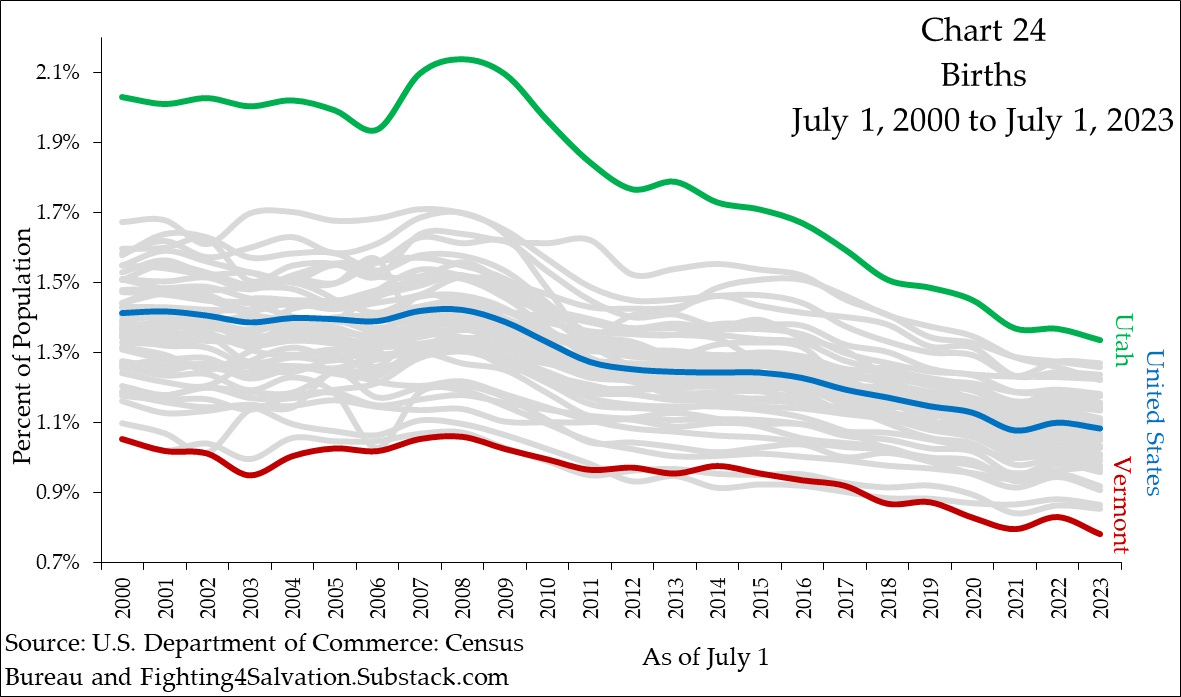
First, the birth rate, or births as a percent of the population, declined from 1.41 percent in 2000 to 1.08 percent in 2017, a change of -23.2 percent (Chart 24). In 2023, the birth rate was highest in Utah, 1.33 percent, while Vermont had the lowest birth rate at 0.78 percent—or 41 percent of the Utah rate.
Interestingly, while Utah still holds pole position, their birth rate has been normalizing toward the U.S. average very quickly since the peak in 2008-2009. I’m not entirely sure what is driving the decline, but there is evidence that Mormons are being priced-out of Utah, especially the Salt Lake City area, and that they are having to move farther away—including adjacent states. And, of course, being replaced by lower fertility populations.
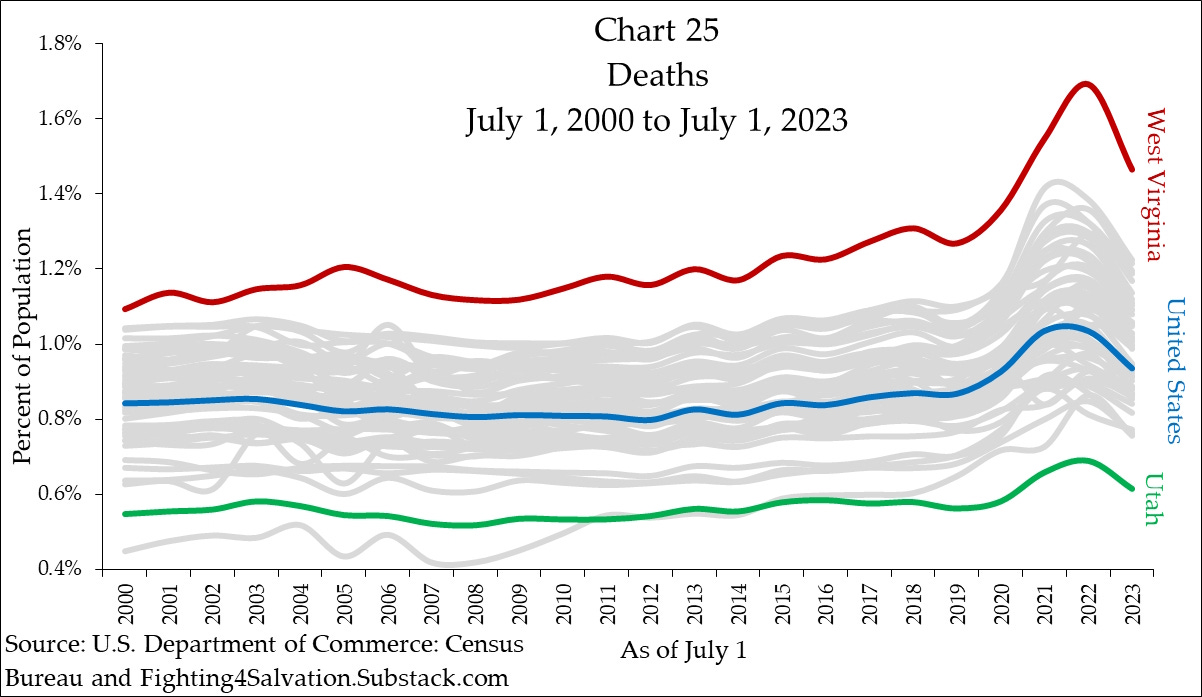
Second, the death rate, or deaths as a percent of the population, increased nationally from 2000 to 2023 (Chart 25) by 11.1 percent. Obviously, the death rate was dramatically increased by COVID in 2021-2022. However, by 2023 it appears the death rate had returned to its pre-COVID trend-line. West Virginia had the highest death rate in 2023 at 1.46 percent, while Utah had the lowest death rate at 0.61 percent—or 58 percent of the West Virginia rate.
Finally, when you subtract deaths from births you get the net natural population growth rate (Chart 26). In 2023, Utah had the highest net natural growth rate at 0.72 percent, while West Virginia had the lowest net natural growth rate at -0.49 percent. More troubling, 19 states had a negative net natural population growth rate in 2023—they are:
Missouri (-0.001%)
Montana (-0.02%)
Delaware (-0.02%)
Ohio (-0.02%)
South Carolina (-0.02%)
Arkansas (-0.03%)
Alabama (-0.03%)
Florida (-0.03%)
Rhode Island (-0.04%)
Michigan (-0.04%)
Kentucky (-0.04%)
Mississippi (-0.05%)
New Mexico (-0.08%)
Pennsylvania (-0.09%)
Oregon (-0.10%)
New Hampshire (-0.15%)
Vermont (-0.28%)
Maine (-0.36%)
West Virginia (-0.49%)
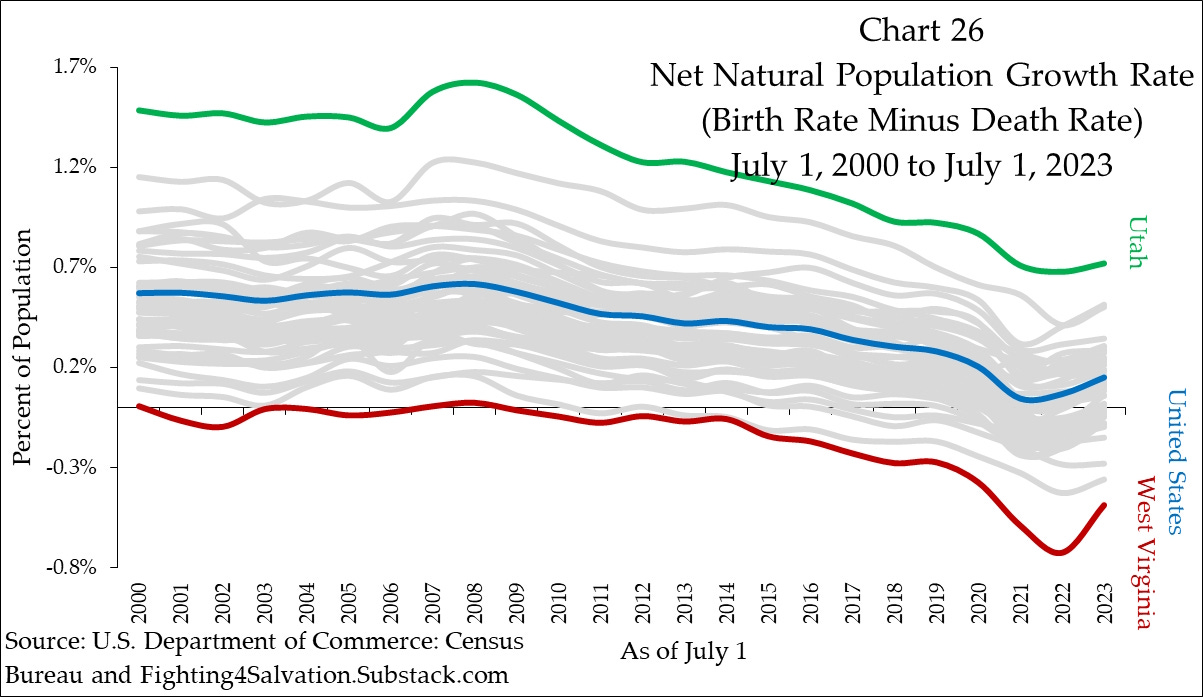
With the net natural population growth rate for the entire country standing at a mere 0.15 percent in 2023, the number of states with negative growth is surely higher today. I think it is safe to conclude from the data that Demographic Winter is here—and here to stay.
So what can we expect from Demographic Winter? Well, my family and I were smacked on the head this weekend from news that the Good Shepherd (Berlin) and Holy Family (Gorham) Parishes will each be losing a weekend Mass. Here is a quote from the Pastor—Father Kyle Stanton—that really sums up the situation:
“Among the other facts I could share regarding the appropriateness for fewer Masses there are three that really stand out. Consider the high number of funderals we continue to offer across our three parishes, about 160 a year. Additionally, active parishioners who attended Mass faithfully now receive communion at their new residence, our local nursing home. Lastly our young adults still tend to relocate to find work and relationships.”
I would add another factor that he doesn’t mention—the lack of weddings. While I don’t have the exact figures, based on my own observations of announcments I would estimate you could count those on two hands, maybe one. So there is also no farm team.
This population dynamic, perhaps more than any other, is what prompted me to develop the idea for Catholic Shires. We all know how hard it is to raise a couple of children, but we need to aim much, much higher. Unfortunately, that is not an easy lift for most.
Mark Steyn has a great phrase: “The future belongs to those who bother to show up.” Devout Catholics must regroup and do so with a very real serious sense of urgency. Our history is littered with enemies who have tried every way imaginable to stamp us out of history. We can not simply fade away with a demographic whimper.
To learn more about Catholic Shires, read the entire ebook here: